
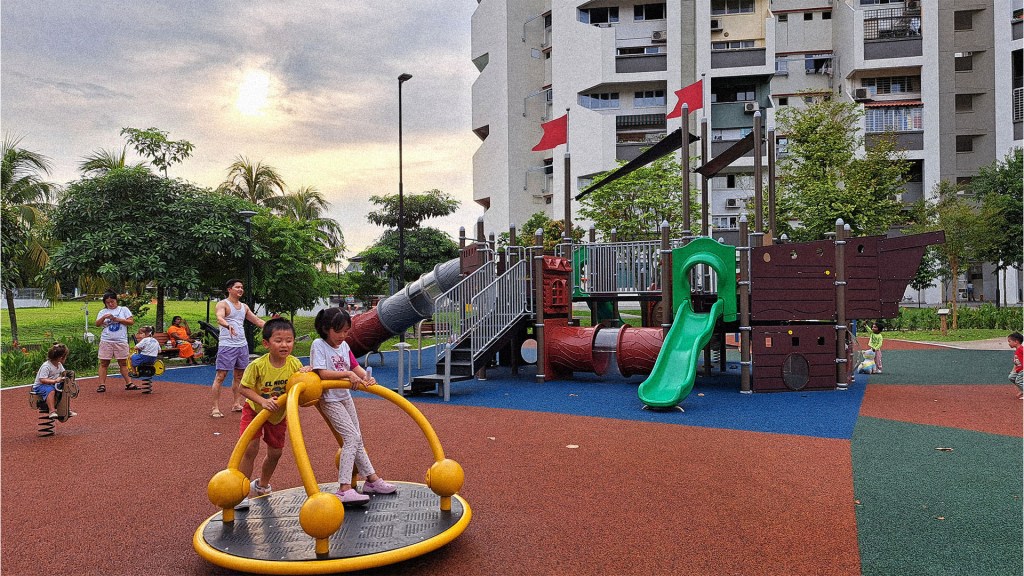
During our “Apparently” webinar on the topic of intergenerational tensions, one frustrated parent asked during question-and-answer: “My in-laws are too protective of my son, I feel. [For] example, at playground, they don’t allow him to climb on his own. But I want him to grow strong. He needs to serve National Service one day. How to deal with these differences?”
Florence, a grandmother of four, responded that she and her husband would warn the grandchildren of the risks beforehand and feel sorry for them if they fall or miss a step at the playground. However, it is a “very good learning experience” for them to go through this.
She cautioned against being “too overprotective” because children would end up not learning much and not really having “a mind of their own”.
This is just one example of tension between parents and grandparents over the appropriate balance between allowing children to take risks on one hand, and keeping them safe on the other.
In this case, the grandparents were the overprotective ones. But the situation could also be the opposite, where parents may be the ones who are overprotective.
What is the harm of being “overprotective” as a parent or grandparent?
Harms of being overprotective
In a 2023 book Risky Play: An Ethical Challenge, philosopher Øyvind Kvalnes and childhood researcher Ellen Beate Hansen Sandseter write that overprotection of children does more harm than good.
According to the writers, people overprotect to make sure that children are “as comfortable as possible and that they do not get injured or feel upset or defeated”. They try to protect children from all negative or harmful experiences.
One term describing this phenomenon is “helicopter parenting”, bringing to mind the image of parents who “hover” over their children to ensure nothing bad happens to them.
Citing various pieces of research, they found various mental health consequences among overprotected children, such as anxiety, depression, withdrawal, loneliness and low self-esteem.
Other negative consequences include having lower levels of autonomy, competence, belonging and self-control, higher levels of narcissism, ineffective coping skills and poor adaptation in the workplace.
Overprotection tells children that they are weak or incapable – and children may start believing this negative message about themselves – as Kvalnes and Sandseter explain:
Overprotective parents can negatively affect their children by communicating that they do not have the skills to succeed in dealing with challenges in the environment around them and life in general. As a result, children may themselves be in doubt about their own competence and coping ability, which in turn makes them more withdrawn and further reduces the chances that they can develop appropriate problem-solving skills…
Though well-meaning, overprotective adults create “learned helplessness” in children. It makes them so used to others solving tangles and sorting things out for them, that they do not develop the ability to master challenges on their own.
Why children need risky play
Play and exploration are important to children’s learning. The authors of Risky Play emphasise:
Play is a child’s primary way of being. Although it exists in various forms throughout the life cycle, play is the arena where children explore opportunities in the environment around them and develop and learn new things. They get to know themselves and what they are capable of. An important element of play is unpredictability, and much of children’s play is about crossing boundaries, stretching limits, trying new things, and putting themselves to the test.
When children encounter risks, they learn to deal with unexpected things in life, and gain courage as well as physical and mental resilience needed to address these challenges.
Thus, they gain essential life experience to understand the level of risk in various situations, and what actions are necessary to handle the risk in a good way. By mastering challenges in their environment, they learn how to manage these and other risks in life safely.
Conversely, the authors point out that young people who lacked opportunities for positive risk instead often engaged in more negative forms of risk, such as petty crime, intoxication or drinking and speeding violation. A study of young people in prison found that they often committed crimes because they sought excitement, due to a lack of leisure activities that provided them the risk experiences and thrills they needed.
Small bumps and bruises are okay
At the end of the day, we need to adopt a fair balance and allow children to be exposed to moderate and age-appropriate levels of risky play.
So let’s allow children to engage in exciting and risky play that can give them positive experiences, while protecting them from more serious forms of harm (but not necessarily any kind of harm).
Remember: Small bumps and bruises are okay! They are a normal part of growing up.
How do we put this into practice?
Let’s take an example: Imagine your three-year old child (or grandchild) is asking to try out the swing at the playground for the first time. It is an exciting experience for him, but there is a risk of falling.
In situations like this, Kvalnes and Sandseter give us two useful questions that we can ask:
- How likely is it that he will fall off the swing?
- How seriously injured can he be from the fall?
It might be likely that the boy will fall off the swing, since it is his first time trying. However, he might only be lightly injured at best because it is a short distance to the ground, which is padded with soft rubber like most playgrounds in Singapore.
Perhaps a reasonable option is to guide the child to sit properly, hold on tight and swing only lightly while you as the parent or grandparent stands ready to catch him if he falls.
Yes, there may always be dilemmas and potential disagreements between spouses, parents and grandparents about what is the acceptable level of risk. Much may depend on the age and maturity of the child, including his or her level of physical and mental development.
But we should remember that risky play brings important benefits to help children flourish in the long-term. As the authors remind us, the goal is to be “as safe as necessary, not as safe as possible”.
 Grander Together
Leave a comment