
Singapore will be a “super-aged” society by 2030, where nearly 1 in 4 Singaporeans will be aged 65 and above. With low birth rates on the other hand, the Government has said that Singapore is being confronted with “the twin demographic challenges” of a persistently low fertility rate and an ageing population.
At the same time, Health Promotion Board statistics from 2012 noted that 35% of seniors over the age of 55 look after their grandchildren on a regular basis, and 1 in 4 households with children under the age of 12 relied on grandparents as the main caregiver. Those were statistics from more than ten years ago. What about now?
In 2024, we published two surveys covering various attitudes and trends surrounding the family (including grandparents). The first was our Parenthood and Work survey, and the second was our Marriage, Family and Social Discourse survey.
Here are some of our findings about the role of grandparents in caregiving, and attitudes towards their involvement.
Grandparents as Caregivers
Dual-career households are now the majority in Singapore, where both husband and wife work. Singapore boasts high levels of female workforce participation, at 62.6%, higher than the OECD (Organisation for Economic Co-operation and Development) average of 56.7%.
As a result, who is going to take care of the children?
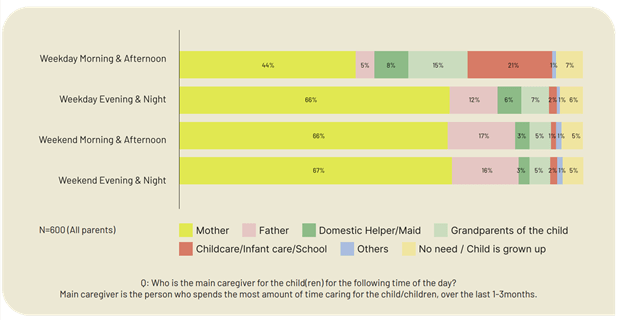
Our 2024 Parenthood and Work survey found that, although mothers are still the most common as main caregivers of children (44%) during working hours (i.e. morning and afternoon) on weekdays, grandparents play a significant role in caregiving of grandchildren ranking third (15%). In second place are institutionalised childcare or schools (21%).
Our survey covered 1,000 Singaporeans, including 600 non-parents.
The survey also found that a good number of grandparents were also involved as main caregivers of grandchildren outside of working hours (7% on weekday evening and night, and 5% on weekends).
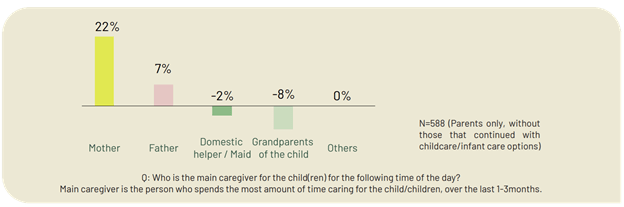
On the other hand, when we compare the roles of various caregivers on weekdays, more mothers (22%) take over caregiving when the child returns home, even though there are fathers (7%) who do so too.
Attitudes Towards Grandparent Involvement
Most elderly in Singapore are willing to provide physical and caregiving support to their families when needed, and also to provide emotional support to their family members.
Encouragingly, people also tend to value the involvement of grandparents.
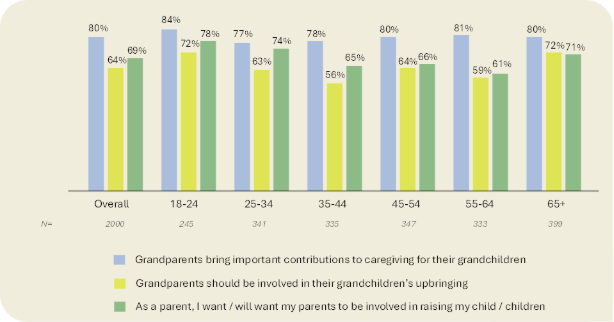
Our 2024 Marriage, Family and Social Discourse survey found that about 8 in 10 (80%) respondents agree that grandparents bring such contributions, and this sentiment is shared across the age groups. Despite such a positive view, fewer respondents believe that grandparents should be involved in a grandchild’s upbringing, with only about 6 in 10 (64%) indicating so.
The survey covered 2,000 Singapore Citizens and Permanent Residents.
When asked whether respondents want or will want their parents to be involved in raising their children, about 7 in 10 (69%) on the overall answered favourably for such involvement. Interest is the highest among the younger respondents (aged 18-34), while those aged between 35-64 are less in favour of it.
Women are less likely than their male counterparts to want their parents to be involved in raising their children. Among women of all age groups, around 6 in 10 (63%) expressed such desires, as compared to around 7 in 10 (74%) among men of all age groups.
The figure was the smallest among women aged 55-64, where only slightly more than half (54%) want their parents to be involved in raising their children. Similar trends were observed for women aged 35-44, where less than 6 in 10 (59%) want their parents to be involved in raising their children.
Should the Government Give Benefits to Encourage Grandparenting?
Currently, the only government benefit (indirectly) applicable to grandparents is the Grandparent Caregiver Relief scheme, which is intended “to provide greater support to working mothers whose parents are helping to take care of their children, and also to recognise the important role that grandparents play in bringing up the next generation.”
It is a $3,000 tax relief given to working mothers who engage the help of their parents, grandparents, parents-in-law or grandparents-in-law (including those of ex-spouses) to take care of their children.
Our 2024 Marriage, Family and Social Discourse survey found that about 7 in 10 (71%) respondents feel that the Government should give benefits to encourage grandparenting, a sentiment relatively shared across the ages.
However, women are less likely to agree to such a view, reflecting a similar pattern with the lower desire to involve their parents in the caregiving of their own children as mentioned earlier. Nevertheless, almost 2 in 3 women (65%) agree that the Government should give benefits to encourage grandparenting.
More to be Done to Value Grandparents?
As these findings show, grandparents have been playing a very integral role in family life here in Singapore, and their involvement in their grandchildren’s lives is highly valued in society.
However, they also raise some concerns.
In spite of the high value that everyone places on grandparental involvement, why are women less likely than men to want their parents to be involved in raising their children. And why is this the lowest among women aged 55-64 and 35-44?
Our survey did not explore the reasons for these differences. However, research by Associate Professor Thang Leng Leng has shown that tensions may arise, for example, “when the grandparents attempt to correct parents on the correct way of raising a child”. This suggests that there may be differences in values and attitudes between the generations.
Regardless, Associate Professor Thang is correct in her observation that “Grandparenting, like any other relationships, is about relationship building.”
The work of relationship building is an ongoing process, which takes time and effort, in order to help the generations thrive.
 Grander Together
Leave a comment