

At our first webinar, “Apparently”, Alison Lim, chairperson of Grander Together and a grandmother of three, shared her insights on navigating the evolving landscape of parenting practices and the dynamics between generations.
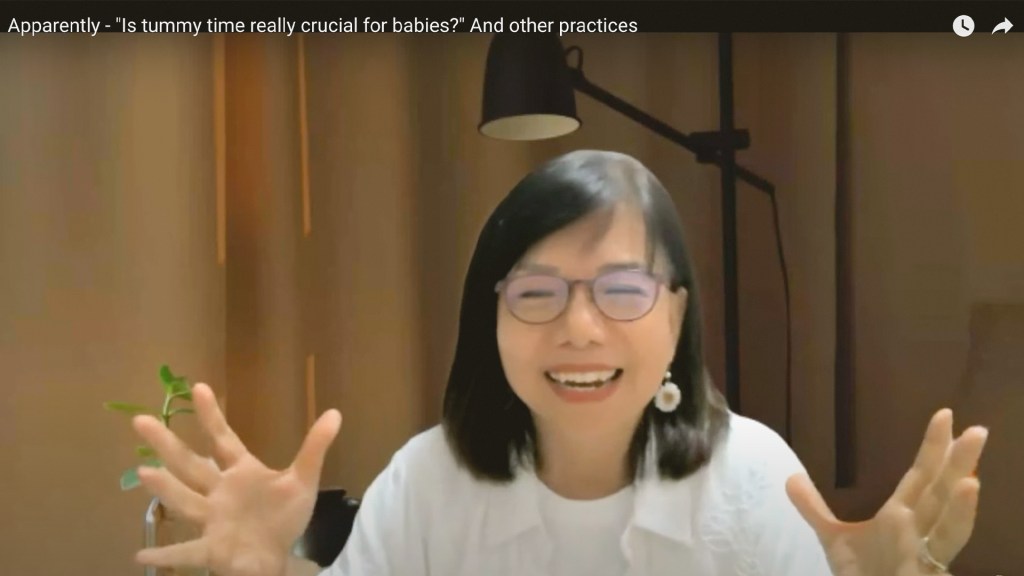
The webinar, “Is Tummy Time Really Crucial for Babies? And Other Practices”, delved into shifts in child-rearing practices and differences between traditional methods and contemporary, research-backed approaches.
Alison shared her ‘GRAND’ framework—a guiding philosophy she developed to enrich her grandparenting journey and support her daughter’s parenting choices.
G – Gratitude
Alison began by emphasising her profound gratitude to her daughter and son-in-law for granting her the privilege of becoming a grandmother. She described this phase of life as one filled with boundless joy, noting that the challenges that come with it seem less daunting when viewed through the lens of appreciation.
“When I remember to be grateful, all the other challenges seem less challenging.”
This gratitude, she explained, serves as a foundation for fostering a positive and supportive family environment.
R – Remember My Role
Understanding her position in the family dynamic, Alison highlighted the importance of recognising that, as a grandmother, she is a “supporting cast member” rather than the “main character”. Despite her extensive experience as a mother, she acknowledged her status as an “inexperienced Grand,” underscoring the necessity of remaining open to continuous learning. She stressed that past parenting experiences do not automatically equip one for grandparenting, as each role presents a unique set of challenges and requires adaptability.
Discipline emerged as a critical area where role clarity is essential. Alison observed that delayed discipline—such as addressing a child’s misbehaviour hours after the incident due to parental absence—is often ineffective. She describes her discipline style as one of mediating and preventing misbehaviour in real-time.
Recognising the differing disciplinary styles between herself and her daughter Ariel — where Alison favoured distraction and mediation, and her daughter adopted a stricter approach — they both agreed on the necessity of establishing clear boundaries and maintaining open communication. Parents should establish what they expect when it comes to discipline and grandparents should respect that. Alison was mindful not to position herself as the “rescuer” during disciplinary moments. She refrained from interrupting her daughter’s parenting decisions, choosing instead to discuss any disagreements privately to avoid undermining her daughter’s authority and to demonstrate respect for her role as a parent.
A – Ask, Don’t Assume
Alison underscored the significance of communication, particularly when confronted with parenting styles that diverge from traditional methods. She noted that even when backed with research supporting new practices, it is not always easy to hear from parents that their ways differ from their own. Finding the appropriate method and timing for these conversations is crucial to understanding and respecting their practices. For Alison, texting became a valuable tool, allowing her to articulate her thoughts clearly and engage in open discussions without the immediacy and potential emotional charge of face-to-face conversations.
She advocated for actively seeking to understand her child’s parenting expectations rather than making assumptions based on her own experiences. By learning the reasons behind her daughter’s parenting choices, Alison aimed to avoid conflicts arising from differing styles and expectations. This approach extended to setting mutual boundaries. For instance, while Alison respected her daughter’s decisions, she found certain practices — like sleep training — to be beyond her comfort zone. She communicated her reservations, and her daughter, in turn, respected Alison’s boundaries, leading to a reciprocal accommodation that honoured both their values without imposing them on one another.
N – No Secrets
Transparency formed another cornerstone of Alison’s framework. She emphasised that being open with parents not only fosters trust but also models honest behaviour for grandchildren. Engaging in secretive behaviour — such as letting grandchildren do something behind their parents’ backs — despite having good intentions to create a fun environment for the child, can erode parental authority and create divisions within the family. Alison cautioned against creating alliances with grandchildren that exclude their parents, as this can lead to unhealthy family dynamics and weaken the overall family structure.
D – Device-Free
In an era dominated by screens, Alison championed the importance of being fully present with grandchildren without the distraction of electronic devices. While acknowledging the convenience of using gadgets to occupy children, she highlighted the challenges that arise when attempting to limit screen time once it becomes a habit. Understanding the detrimental effects of excessive screen exposure motivated Alison to engage more directly with her grandchildren. This commitment to presence was reciprocated; her granddaughter began reminding Alison to put away her phone, illustrating how mindful behavior can influence younger generations positively.
Alison concluded by reflecting on societal expectations surrounding grandparenting. She recounted how, upon becoming a grandmother, she was often told it was her time to spoil her grandchildren. However, a quote—” grandchildren are too precious to be spoiled”—resonated deeply with her and prompted a shift in perspective. She came to view her role not as one who indulges, but as a partner alongside her daughter in nurturing and guiding her grandchildren. Alison emphasised that embarking on the journey of grandparenting requires a willingness to learn and adapt, embracing the challenges that come with striving to be the grandmother she aspires to be.
GRAND Framework
Through GRAND, she demonstrates that being an effective grandparent is not about spoiling, but about guiding, supporting, and cherishing the privilege of family. Alison admits that her journey as a grandmother is still a work in progress as she learns new things about her grandchildren, her daughter’s parenting style, her dynamics with her daughter, and her new role.
Catch the full webinar here:
 Grander Together
Leave a comment