

Who is more involved in caregiving of children: Grandfathers or grandmothers?
In a 2019 research monograph, the Singapore Children’s Society sought to investigate the impact of caregiving arrangements on mother-child attachment in Singapore. Its report contained some very interesting data on the roles of grandparents as caregivers.
Given our Asian society, the results are interesting but not surprising: Grandmothers were far more common as main caregivers of children, compared to grandfathers.
Indeed, grandfathers were rarely main caregivers of children.
Grandfathers are Rarely Main Caregivers
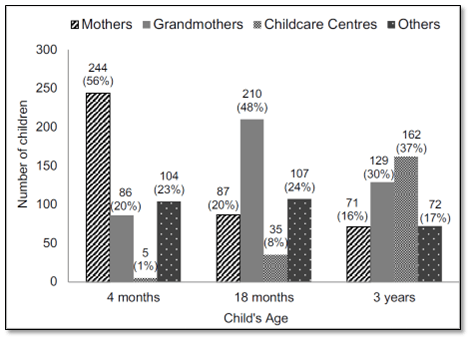
According to the study, grandmothers were typically the main caregiver of their grandchildren at 18 months of age, while mothers were typically the main caregiver of children at 4 months of age. At 3 years of age, childcare centres were typically the main caregiver.
The study was based on 439 mother-child pairs. The mothers were all Singapore citizens or Permanent Residents who delivered healthy firstborn infants at KK Hospital, who were then interviewed when the infants were 4 months, 18 months, and 3 years of age.
Source: Singapore Children’s Society, “The Infancy Study: The Impact of
Caregiving Arrangements on Early Childhood Development” (July 2019)
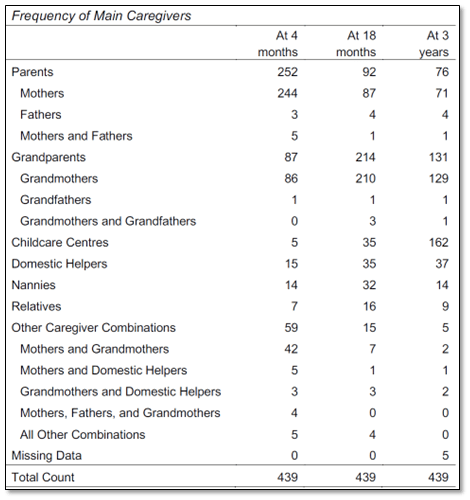
The study found that very few children had their grandfather as their main caregiver. As the table below shows, only one out of the 439 children had their grandfather as main caregiver at 4 months, 18 months and 3 years of age.
Source: Singapore Children’s Society, “The Infancy Study: The Impact of
Caregiving Arrangements on Early Childhood Development” (July 2019)
These shifts in caregiving arrangements at 4 months, 18 months and 3 years respectively correspond to our social realities of childcare. Until the recent changes to Shared Parental Leave in Singapore, eligible working mothers were entitled to a total of 16 weeks’ maternity leave.
Furthermore, children become eligible for playgroup and other childcare services from 18 months of age onwards.
Why Grandmothers Do More Caregiving
The study suggested that grandmothers took on a larger share of the caregiving responsibility because of the “gendered division of labour”. This means that “women [undertake] traditional caregiving roles to a greater extent than is commensurate with their current levels of education and employment”, even though grandfathers may have contributed in different ways.
Grandmothers were also likely to be more experienced at caregiving than first-time parents.
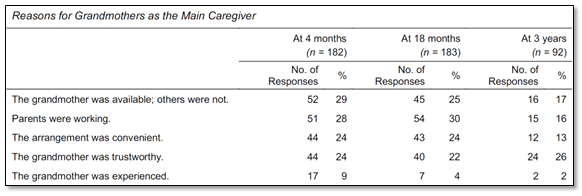
When mothers were asked why they placed children in the care of grandmothers, they gave various circumstantial and practical reasons, and expressed trust in the grandmothers:
- Both parents were working;
- Grandmothers were available;
- It was convenient (because grandparents tended to live nearby); and
- Placing the child in the care of immediate family members provided mothers with greater assurance and peace of mind.
Source: Singapore Children’s Society, “The Infancy Study: The Impact of
Caregiving Arrangements on Early Childhood Development” (July 2019)
Cultural reasons may also play a role, according to another study by Suzanne S. H. Low & Esther C. L. Goh in 2015 among ethnically Chinese grandmothers. They said that grandmothers were willing to make sacrifices for their adult children and grandchildren because of a strong sense of familial obligation in Chinese culture (gu rou, which can be translated as “flesh and blood”).
Both Grandparents Have Important Contributions to Make!
Although grandmothers are far more often involved as main caregivers of grandchildren, does that mean grandfathers do not and should not have any role to play?
Not at all! Both grandfathers and grandmothers are important.
Cultivate SG’s 2024 Marriage, Family and Social Discourse survey found that about 8 in 10 (80%) respondents agree that grandparents bring important contributions to caregiving for their grandchildren, and this sentiment is shared across the age groups.
In fact, there is talk of the “new grandfather” as caregiver, who ferries grandchildren to school and extra classes, plays with grandchildren, and there are some grandfathers who are full-time caregivers. Grandfathers have also seen the value of transmitting moral values and heritage to their grandchildren.
For example, in an article published on Silver Streak, Benjamin Goh wrote of his experience doing “mundane stuff” like taking grandchildren to various classes, as well as “fun things” like “make believe play, pretend play and silly things”. He also spoke of reinforcing the values and ethos being taught by parents.
So, whether you are a grandfather or grandmother (or have one or know someone who is one), remember that you have your unique contributions to make!
 Grander Together
Leave a comment