
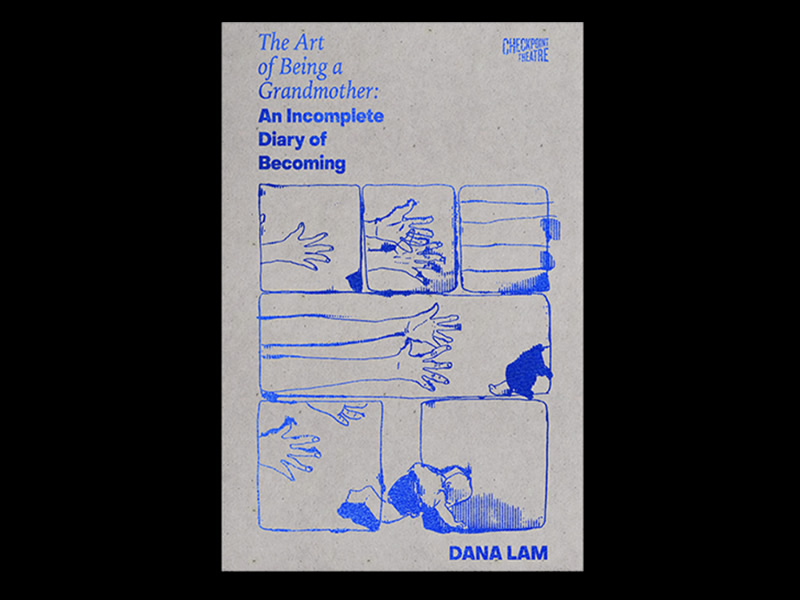
Dana Lam’s The Art of Being a Grandmother: An Incomplete Diary of Becoming is a collection of diary entries and illustrations by Lam herself, recounting the hardships and joys she experiences on her journey into grandmotherhood. Through intimate reflections, she explores the evolving nature of this role, capturing both its emotional weight and unexpected delights. The book is a collection of her diary entries through her grandmothering years. She encapsulates her journey not just through writing but through her illustrations.
The illustrations by Lam herself, reflects both her identity as a visual artist and her deeply personal storytelling approach. Her drawings are often abstract, raw, and free-flowing—sometimes explicit and detailed, other times seemingly random or open to interpretation. At moments, they serve as direct extensions of her emotions and experiences, enhancing the diary entries. At other times, they stand alone, telling their own stories without the need for accompanying text.
Lam’s illustrations capture a wide spectrum of emotions — humour, struggle, joy, and sorrow. A defining feature of her artwork is her use of space, texture, and gradients to reflect the tone of each moment. This is particularly evident in the early illustrations depicting the birth of her first grandchild. In moments of chaos or distress, she employs harsher tones, smudged paint, and densely packed images, creating a sense of tension and overwhelm. In contrast, calmer scenes are marked by softer lines, brighter tones, and a more open composition, evoking warmth and ease.
Throughout the book, there are few scattered scribbles in the margins that resemble fleeting thoughts, adding an intimate, almost unfiltered quality to her storytelling. She also uses spatial composition to communicate distance—most notably in her depictions of separation from family during the COVID-19 pandemic. Some illustrations act as direct continuations of previous ones, while others shift entirely in style and meaning, creating an unpredictable rhythm that mirrors the complexities of grandmotherhood. In some cases, her drawings exist independently from the text, telling parallel stories or carrying their own handwritten notes overlaid onto the imagery.
Through these varied artistic choices, Lam’s illustrations do more than accompany her words—they breathe life into them, offering readers a visual and emotional dimension to her reflections on family, aging, and the ever-evolving role of a grandmother.
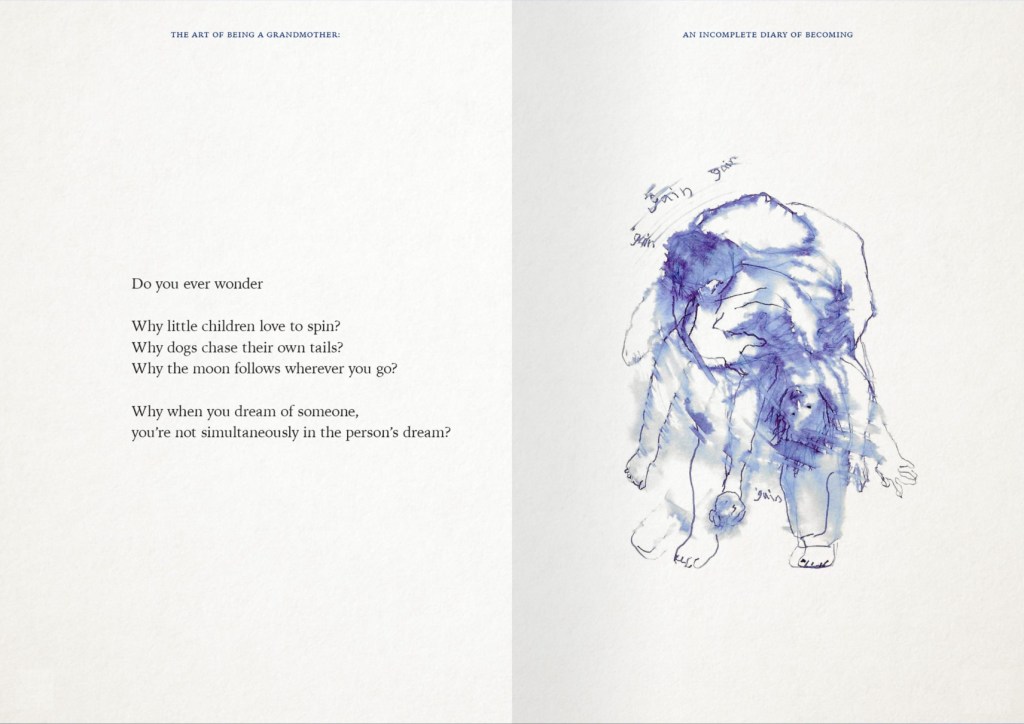
Extract from Dana Lam’s The Art of Being a Grandmother
Source: Checkpoint Theatre
The paradox of her title suggests that the skill and ability of being a grandmother is not necessarily defined by certainty or expertise, but rather by the unknown, the new, and the messiness of the process. The phrase “the art of” conveys an air of mystery and wisdom, implying that grandmothering is something to be cultivated and learned from. Yet, this is immediately undercut by “an incomplete diary,” suggesting that the journey is ongoing, and that the act of becoming a grandmother is not a singular event marked by the birth of a grandchild, but a continuous process of adaptation and learning. Lam presents an evolving narrative, one in which each year, each experience, and each grandchild refines and reshapes her understanding of what it means to hold this title. This paradoxical shift embraces the idea that wisdom is not a static attainment but rather an accumulation of insights gathered through lived experience.
Her book reflects on her personal growth as a grandmother, not just to one grandchild, but to four in the span of seven years. She notes that becoming a grandmother is not a choice of one’s own, but “a decision made for you by someone else.” In doing so, she highlights a shift in autonomy; where once she had authority over her own child, she now grapples with the reality of having limited control over her grandchild’s upbringing. This tension is particularly evident in her account of being denied entry to the labour and delivery ward when her first grandchild was born. The moment serves as a stark realisation that her role, though significant, is secondary. She poignantly reflects, “If mothering is an affair of the heart, grandmothering is an affliction of the nervous system,” encapsulating the anxiety, care, and love that intertwine in this new stage of life.
Despite this lack of control, there is an undeniable instinct that compels her to care for her grandchildren. Love, rather than authority, becomes the guiding force of her grandmothering. The book does not attempt to prescribe rules or offer didactic advice but instead provides a deeply personal meditation on the experience. Her perspective is both tender and candid, revealing the daily struggles and small victories of grandmotherhood. She writes, “Being a grandmother is like getting a second chance,” acknowledging the unique joy that comes with being able to love and nurture without the same pressures that accompanied motherhood.
Lam also grapples with the broader changes in family dynamics, particularly in the wake of the COVID-19 pandemic. The enforced distance and disruptions to familial bonds highlight the fragility of connection. The inclination to grandmother, to nurture, to be physically present, is abruptly put on hold, forcing a reassessment of what it means to be present in the lives of her grandchildren in a time of separation. These moments of loss and longing add a layer of melancholy to the book, reinforcing the notion that grandmotherhood, like all relationships, requires constant negotiation and adaptation.
At its core, The Art of Being a Grandmother is not a manual but a reflection—a deeply personal, honest, and resonant account of the joys and challenges of stepping into this new phase of life. Lam’s prose is gentle yet unflinching, her insights universal yet uniquely her own. The book serves as a companion to those navigating similar transitions, offering both solace and recognition in its beautifully imperfect portrait of grandmotherhood.
Dana Lam’s “The Art of Being a Grandmother: An Incomplete Diary of Becoming” is published by Checkpoint Theatre. It is edited by Huzir Sulaiman, with curation, design and layout by Marc Gabriel Loh. The book is available for loan from the National Library Board.
 Grander Together
Leave a comment