
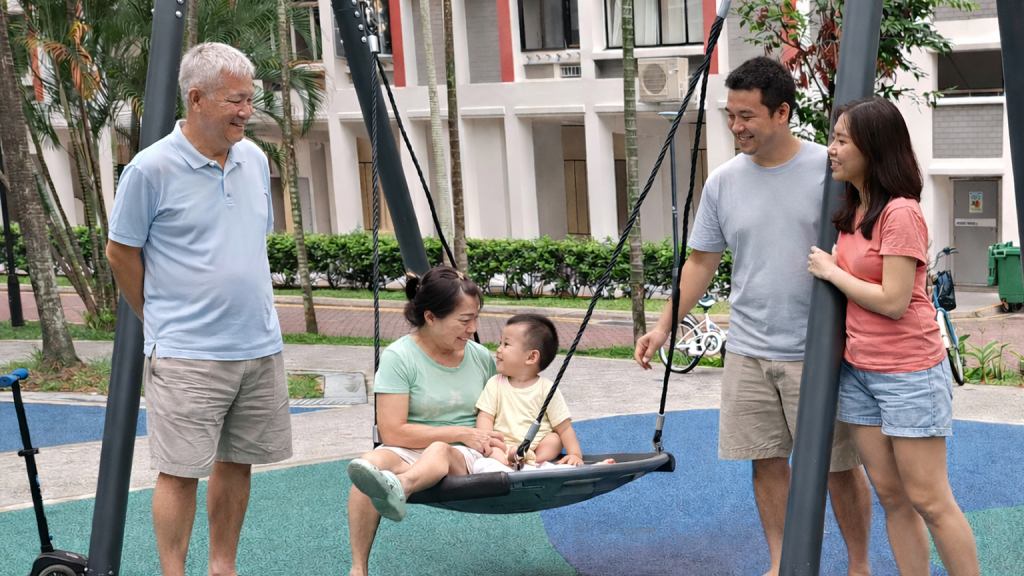
Close relational ties within multigenerational families are the cultural ideal in Singapore. The concept of filial piety is deeply rooted in Asian culture, which values seniority and solid intergenerational ties as notions to be rooted in the way of life. These concepts are built into our hearts and minds, yet the manner of practice can differ greatly from this idea.
Kalyani K. Mehta and Thang Leng Leng’s chapter “Multigenerational Families in Singapore”, in the book Ageing in Southeast and East Asia: Family, Social Protection and Policy Challenges (2015), sheds light on these realities.
The study highlights the idea of reciprocity within a three-generational unit, how grandparents shape household relationships, and how their bonds with adult children influence their relationships with grandchildren. It finds that active involvement and care by grandparents strengthen generations.
Exploration of Practice and Interdependence
Reciprocity is an important part of multigenerational relationships, where an older person need not solely be the receiver but a participant and provider as well. Such reciprocity ends if relationships break down. Whether the exchange is mutually beneficial or not, and the extent of it, is also determined by the elderly’s health.
Amidst the vastly changing social and economic landscape, there are questions of whether the idea of filial piety would prevail in the time to come. However, the authors noted that interdependence continues to be highly valued.
Within this context, the authors explore how each generation perceives their roles with the older and younger generations in the family.
1. Child Care
Grandparents often see their roles in the physical aspect, “taking care of grandchildren physically,” when the grandchildren are small. An interviewee described how caregiving, while the adult children (i.e., parents of the grandchildren) are at work, took much time and effort.
This physical aspect of caring has a “time lag”; often, the care is confined to the early years of a child. Grandparents take care of their grandchildren when the grandchildren are young, and the adult children (i.e., parents of the grandchildren) to the grandparents when they become older. Grandparents offer caregiving relief for their parents.
2. Financial
Grandparents find it natural for their adult children to take care of their financial needs in old age, because the grandparents provided for the (now-adult) children when they were young. This is rooted in the traditional idea of filial piety, or a continuation of the traditional “contract”.
3. Transmitting Values and Cultures
Grandparents are important transmitters of values and culture, the “wardens of culture”. However, generational differences create resistance; grandparents also help adapt and reshape values over time by creating new shared stories that keep traditions meaningful. Additionally, grandparents view themselves as supportive mentors, especially in guiding and nurturing their grandchildren’s religious beliefs.
4. Emotional
Grandparents express joy in having grandchildren. Grandparents see contentment and satisfaction in having grandchildren. It is further enhanced by seeing their grandchildren flourish into adulthood. There is a sense of pride in seeing their grandchildren succeed; often, grandparents flaunt it through their speech and actions towards their grandchildren.
5. Spending Time Together (Leisure)
The idea of spending time with each other need not be a big thing; it can often be meals, watching television, showing affection through actions, and even travel when permitted. Starting early in a child’s life sets a precedent for them as they grow older on how to treat their grandparents. As seen in an interviewer’s recount of how her grandchildren, whom she cared for, are now able to come and visit her on their own accord.
Factors that Affect the Relationship
However, there are some factors that can affect the extent of interdependence between the generations.
- Living arrangements. Children in Singapore live with their parents up to the point of marriage, partially due to housing policies. It is generally observed that those who live with their parents tend to be closer in their relationship. This is the same as grandchildren living with their grandparents.
- Gender. Grandchildren seemed to be closer to their grandmothers than to their grandfathers.
- Care-giving aspect. If there is consistent care from a young age, it is observed that the grandchild will be closer to their grandparents as they grow up.
The role of the middle generation is important in facilitating and cultivating relationships, creating opportunities for interactions. They are role models on how to interact with grandparents, and how they perceive their parents affects their children’s perception.
However, some grandchildren see themselves as bridges. They are people whom both generations care deeply about, “magnets” that draw their parents and grandparents closer.
Social and economic changes, higher literacy rates, nuclear families, demanding work, and school cultures have impacted bonds. Peers and academics become priorities, and language barriers and differing interests further widen the gap.
Looking ahead, future grandparents are expected to be more educated and adaptable, but may have different priorities and retirement plans that do not centre on caregiving. With families studying or working overseas, this may further affect intergenerational closeness.
Implications and Future Challenges
Due to the changes in today’s world, there are some implications and future challenges.
Grandparents may feel displaced because of their lack of skills and abilities to keep up in today’s world. In response, they withdraw and isolate themselves.
However, other grandparents may adapt, recognising the need to keep up with the times and actively familiarise themselves with the use of technology. Even learning from the younger generations to better communicate with them.
A respondent reflected that caring for older generations involves both physical and cognitive aspects. When his father migrated to Singapore, his mental and physical capacity slowly declined, and he became alienated from technology. The change of environment affected how he learnt and engaged.
Conclusion
Strengthening intergenerational bonds requires intentional efforts from all. Families can prioritise regular engagement to deepen the relationships. Adult children should model behaviours to grandparents and facilitate interactions between the generations. Grandparents are key to transmitting values, while gaps in perspectives, interests, and communication are inevitable between generations, adapting and willingness to learn and teach each other through is important.
Sustaining the benefits of multigenerational families requires balancing independence and interdependence. Intentionally nurturing relationships and maintaining mutual respect, adapting traditions and communications, sharing new activities, strengthens the bonds and ensures meaningful impact and transmissions of values.


Leave a Reply